
The Body-wide Web
A new circulatory system has been discovered, and it’s big.

“Anatomy is destiny.” —Sigmund Freud
How is it possible that we’re still discovering new human anatomy in the 21st century? This is a story about two new anatomical features, one small and one large, and their important roles in the gut-brain axis.
Holding organs in place
Our organs are strapped in place by a patchwork of tissues. It is a web of tough collagen and elastin fibers suffused with hyaluronic acid, which attracts water to create a gel. That gel ebbs and flows, accompanied by a smattering of cells, microbes, and molecules.
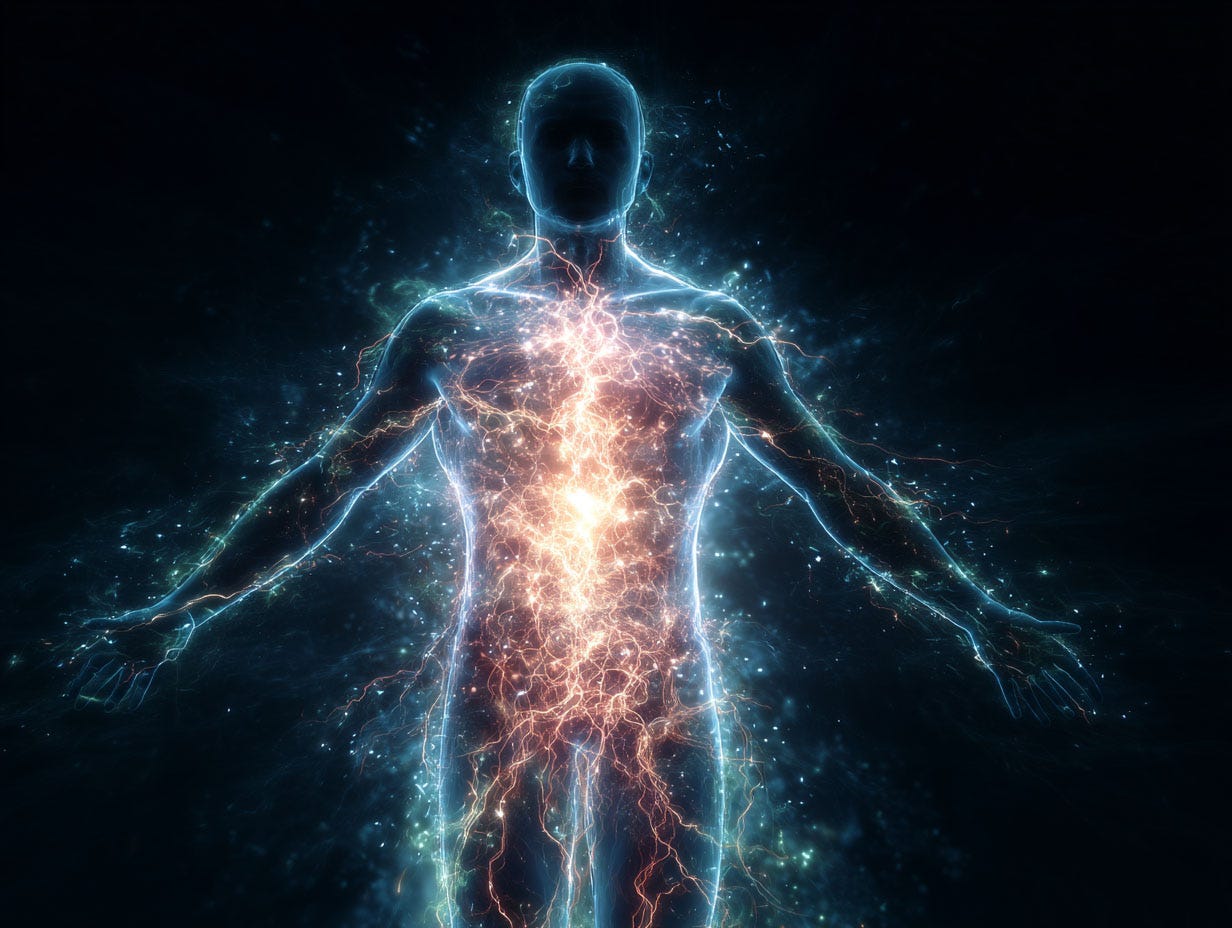
Recently, a landmark study by Dr. Neil Theise and colleagues showed that all these patches are connected into a single continuous, body-wide tissue. If it were considered an organ, it would be the largest organ in the body, demoting the skin to close second. But most researchers, including Dr. Theise, consider it to be a mere tissue, which is a little disappointing.
This organ has a name that proves biologists don’t have a PR department: the Interstitium. We’ll just have to wonder how much farther this news would travel if it were called the Megaplex or the Body-wide Web.
The interstitium isn’t just large, it is all-encompassing. As well as your organs, all your blood vessels and nerves run through it.
Unlike the circulatory system, there is no heart to pump the interstitial fluid. But it gets movement from many directions. The pulsing of arteries gives it a soft rhythm. The larger movement of your bowels adds another cadence. On top of that, every flex of your muscles squeezes it like a sponge, pumping fluid throughout. It never sleeps.
Microbes enter the picture
When the gut is inflamed, it can become leaky, allowing toxins and microbes to break through the delicate gut lining. When they do, they find themselves in the interstitium. Microbes are ready for this; some of them have an appetite for hyaluronic acid, and they can eat their way through the interstitium on their way to other organs.
In close pursuit, immune cells send out tendrils through gaps in the interstitium, following the microbial trails. When they capture a microbe, they then worm themselves toward lymphatic vessels to dump them into the trash.
That means, along with the vagus nerve and the bloodstream, the interstitium provides a whole new superhighway for gut microbes and their metabolites to affect the brain. The researchers noted that “the interstitium is a route for microbiome signaling.” I wrote to Dr. Theise to ask him about the microbial connection. He replied, “I’ve been waiting for someone, anyone, to take note that we keep mentioning this in our papers.”
Microbial signals can be positive or negative. Are interstitial microbes pathogens, or have some of them set up a healthy community? Theise says, “it is unclear. I suspect it is largely sterile, but bacterial products or fragments traffic through it routinely.”
Still, he says, “the interstitium certainly is a missing piece of any pathway for microbial signaling.” That’s because, for any microbes or toxins to enter the bloodstream or affect a nerve, they must first pass through the interstitium to get there.
The other circulatory system
Blood vessels are not the only circulatory system in the body. There is also lymph. It doesn’t have a pump, but it circulates due to one-way valves throughout the system. As your body goes about its metabolic business, it produces a lot of waste products. These are sucked up by the lymphatic system which ferries them to the blood and then to the kidneys for removal. But the lymphatic system doesn’t seem to extend to the brain. How brain waste is removed has been a long-standing mystery.
That is, until 2013 when Danish neuroscientist Maiken Nedergaard discovered small channels alongside veins in the brain that did the job. She called it the glymphatic system. Among other things, it is in charge of eliminating the amyloid molecules that build up in Alzheimer’s disease.
I asked Theise if there was a connection between the interstitium and the glymphatic system. He said, “Yes, and a lot of folks are thinking it is a primary, or the primary drainage pathway of the glymphatic system.”
Could this be a pathway for microbes to communicate with the brain? Theise says, “One of the biggest hurdles for gut-derived molecules affecting the brain is the blood-brain barrier. However, a continuous interstitial pathway means that gut-derived signals might find a more direct anatomical ‘back door’ into the central nervous system’s fluid compartments.”
The Chinese connection
There is another interesting angle to this research: the network of elastin and collagen is unexpectedly piezoelectric, meaning that if you press it or bend it, it will generate electricity. This is intriguing, because electrical signals generated by piezoelectric materials may play a role in processes such as bone healing, nerve regeneration and skin repair. In addition, hyaluronic acid has a negative charge, so the electrified matrix may push it around through electromotive forces.
This squishy electric network bears an uncanny resemblance to the Chinese notion of Qi, the circulating life force. Could the piezoelectric fibers explain the workings of acupressure or acupuncture? This is something that researchers are starting to explore.
If so, the gut-brain axis, via the interstitium, may yield to some ancient leverage, and give us new tools to manage our moods, memory, and cognition. Not bad for an anatomical feature we only recently discovered.
References
Benias, Petros C., Rebecca G. Wells, Bridget Sackey-Aboagye, et al. “Structure and Distribution of an Unrecognized Interstitium in Human Tissues.” Scientific Reports 8, no. 1 (2018): 4947.
Theise, Neil D., Mehran N. Kohnehshahri, Luis A. Chiriboga, et al. “Evidence of Interstitial Continuity within and beyond the Human Pancreas.” Human Pathology 161 (July 2025): 105855.
Iliff, Jeffrey J., Minghuan Wang, Yonghong Liao, et al. “A Paravascular Pathway Facilitates CSF Flow Through the Brain Parenchyma and the Clearance of Interstitial Solutes, Including Amyloid β.” Science Translational Medicine 4, no. 147 (2012): 147ra111-147ra111.
Wu, Yifan, Junwu Zou, Kai Tang, et al. “From Electricity to Vitality: The Emerging Use of Piezoelectric Materials in Tissue Regeneration.” Burns & Trauma 12 (July 2024): tkae013.
I appreciated how you kept the wonder and the brakes in the same piece. The interstitium as a possible route for microbial signaling puts the gut-brain connection in a new light for me: molecules and receptors are still there, but now anatomy, pressure, flow, and passage enter the conversation. The ancient parallels feel extremely valuable too, and prompt us to ask deeper questions.
It is encouraging to see the interstitium being acknowledged as a major biological discovery. However, a critical blind spot remains: as a transport medium, it is not merely a structural compartment but a system governed by the physical constraints of diffusion. Understanding those constraints may be essential for understanding both health and disease.