
Exercise Your Microbes, Part 1
We know exercise is good for us. But it’s also good for our microbes.

“In my seventies, I exercised to stay ambulatory. In my eighties, I exercise to avoid assisted living.” —Dick Van Dyke
Take it from a writer: It’s easy to sit on your butt all day. It’s also a surefire way to grow frail and unhealthy. I’ve been humiliating myself this way for years, so you don’t have to. It took a while to crawl out of that hole (especially after all my muscles became atrophied). Exercise was the key to recovery. I thought I had a good exercise plan already, until someone pointed out that running a bath and jumping to conclusions were not actually exercises.
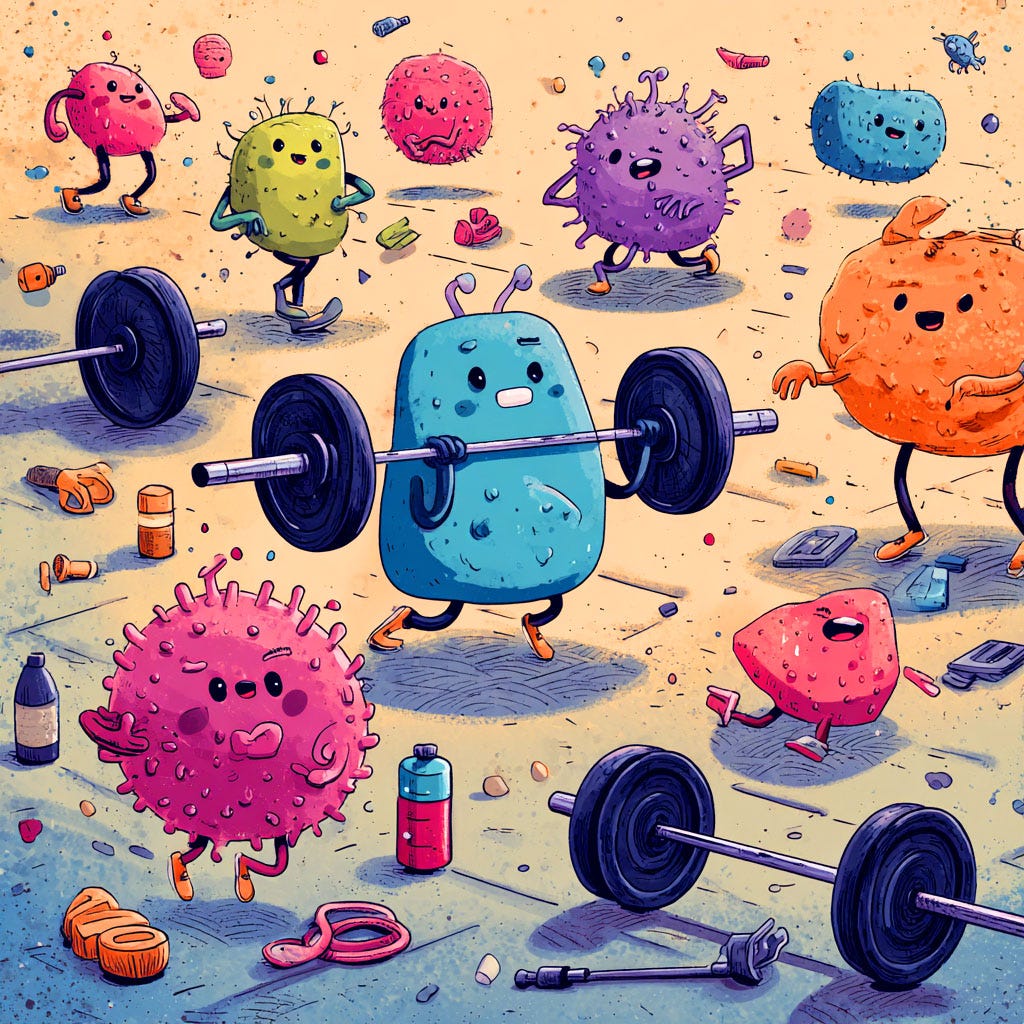
We have two circulatory systems: blood and lymph. There is no equivalent of the heart to pump lymph, so you need to move your body in order to circulate it. Most of the gut–brain story involves immune health, and the lymphatic system is the main highway for immune cells. If you don’t move, your lymph doesn’t circulate and your immune system stalls. So, as comfy as that chair is, we need to get off our butts. We mustn’t let our lymph loaf.
Before you exercise, stretching is recommended, especially if you’re tight. Some kinds of stretches are an exercise all on their own. For instance, people carry a lot of tension in their shoulders and neck, often without knowing it. But tension is a part of the stress response that can unintentionally double back on you.
Don’t let tension build up and spoil your mood. Tilt your head forward and then slowly roll it around. Look left and right. Go a little farther with each movement to increase your freedom of motion. Make faces, especially smiles. Roll your shoulders around. Do it now and don’t worry about who is looking. Feels good, doesn’t it? (Who says Substack can’t be interactive?) It’s surprising how therapeutic a little stretching can be.
Snuffing inflammation
Inflammation may be the single most important factor when it comes to health, resilience, and successful aging. Exercise lowers inflammation. In addition, exercise improves the toughness of your gut lining, further reducing the odds of inflammation. Exercise also improves the quality of your microbiome. A classic Irish study from University College Cork, showed that rugby players, exemplars of exercise, have a more diverse gut microbiome than the rest of us.
As we age, we start to lose muscle tone. So, even if you’ve never exercised a day in your life, you may need to take it up when you get older. Fortunately, you can build muscle at any age. Exercise works quickly. You can grow new muscle within days of weightlifting. Because you gut lining and microbes are also improved with exercise, you can double the effect.
Exercise and a proper diet are the two most important things we can do for our resilience and mental health. Being a couch potato is surprisingly damaging to your well-being. Evolution has not properly prepared us for bingeing on Netflix.
Inflammaging
There is an intriguing relationship between exercise, your gut microbes, and your brain that changes as you age. This relationship can be especially fraught in the elderly. The general descent into arthritis and other inflammatory diseases of old age is called inflammaging.
Exercise prevents hypertension and improves vascular function, both of which are associated with better cognition and resilience. But there are many other ways that exercise is a boon to your health:
Exercise promotes the growth of nerve cells. In sedentary people, the brain tends to shrink with age. But the hippocampus, a brain structure involved in memory and cognition, actually grows in size with exercise, like a muscle. Remarkably, exercise rejuvenates your brain.
Exercise modulates insulin levels as well, potentially exerting a beneficial effect on diabetes and obesity, syndromes that occur together often enough to earn the term “diabesity.” Insulin resistance is behind type 2 diabetes. A similar phenomenon occurs in Alzheimer’s, leading some researchers to label Alzheimer’s type 3 diabetes.
Exercise lowers inflammation, protecting the brain from injury. Inflammation may be the most important aspect of the exercise-gut-brain connection. In addition, experiments show that exercise improves the integrity of the gut lining. That keeps gut bacteria out of the bloodstream, and indeed, athletes show lower blood levels of molecules associated with bacterial infection.
Exercise promotes the growth of good bacteria. Active people have higher levels of healthy microbes than sedentary people. These beneficial bacteria are boosted in athletes and depleted in people with obesity or diabetes. Among other mechanisms, exercise increases the level of bile acids, which encourages the growth of beneficial bacteria. These microbes can produce so-called “secondary” bile acids that can then be consumed by other beneficial microbes, spreading the cheer.
Some of the bacteria that love exercise include Faecalibacterium prausnitzii, Roseburia hominis, Veillonella, Streptococcus suis, Clostridium bolteae, Anaerostipes hadrus, Lactobacillus acidophilus, Lachnospiraceae, Erysipelotrichaceae, and Akkermansia muciniphila. Many of these microbes are butyrate producers, boosting the health of your gut lining.
The encouraging upshot is that exercise is not just good for the human body. It’s also good for your gut microbes, leading to sharper cognition and pumped up resilience. That in turn can boost your exercise regimen.
In Part 2 of this article, we’ll learn more about the many ways there are to exercise for the health of your microbiome. All of them are beneficial; you just need to figure out which of them best suit your lifestyle. Make sure you’re subscribed so you don’t miss out!
References
Varghese, Sanish, Shrinidhi Rao, Aadam Khattak, Fahad Zamir, and Ali Chaari. “Physical Exercise and the Gut Microbiome: A Bidirectional Relationship Influencing Health and Performance.” Nutrients 16, no. 21 (2024).
O’Brien, Marcus T., Orla O’Sullivan, Marcus J. Claesson, and Paul D. Cotter. “The Athlete Gut Microbiome and Its Relevance to Health and Performance: A Review.” Sports Medicine, ahead of print, 2022.
One of my favorite Substacks. Well written and consistently informative. You encourage in a gentle way that is difficult to master as a writer.
Brillaint connection between lymphatic circulation and microbiome health. Never thought about the no-pump problem with lymph beforebut it explains why sedentary days always feel sluggish. The inflammaging concept is a useful frame for thinking about exercise as preventative care.