
Cognitive Behavioral Therapy and the Microbiome
It seems crazy that talk therapy could improve your gut microbes. Is it true?

“I told my psychiatrist that everyone hates me. He said I was being ridiculous - everyone hasn’t met me yet.” —Rodney Dangerfield
Cognitive Behavioral Therapy (CBT) is a powerful and popular tool for mental health, and although it’s a psychological intervention, it affects our bodies as well. How in the world does that work?
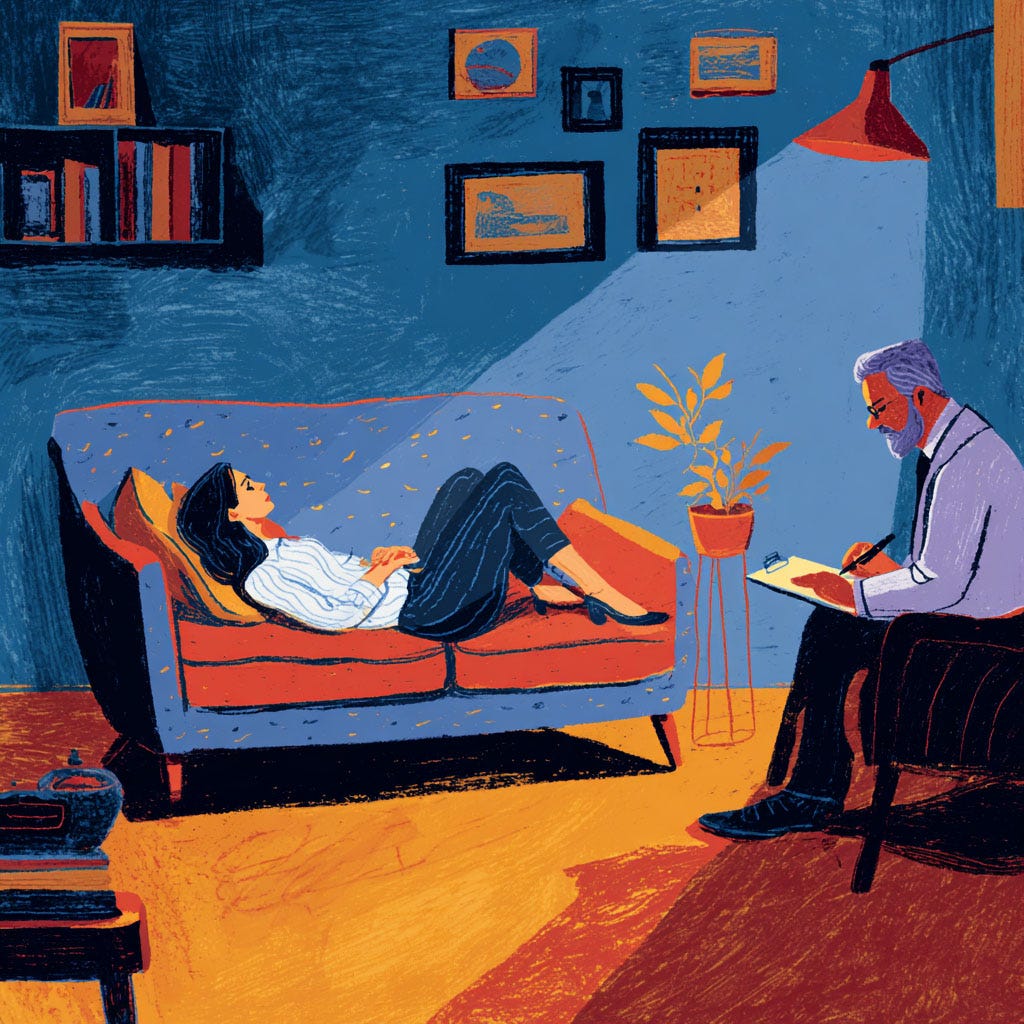
CBT is often described as goal-oriented, which means that you and your therapist decide to work on specific goals with the expectation that a dozen or so sessions should suffice. Contrast that to the open-ended field of psychodynamic therapy that, if the psychiatrist is lucky, can last a lifetime.
CBT is a form of talk therapy, designed to manage depression and anxiety, among other emotional concerns. It emphasizes that psychological issues are often due to sloppy thinking. Few of us are qualified in psychology, yet we feel no compunction about armchair-analyzing ourselves and then using that amateur framework to guide the rest of our lives. Mostly, we’re completely wrong: our mother didn’t ruin our lives, it just makes a convenient story.
CBT helps people identify, challenge, and change negative thought patterns and behaviors. It’s based on the idea that those thoughts and behaviors are interconnected and controllable. It offers the chance to analyze those connections and then bring them to the surface to rewire them.
Internal voices
Our self-thoughts — what the voices in our head say about us — can give rise to strong emotions. When we’re depressed, we tend to ruminate on negative emotions. A lot. We replay our embarrassments, shortcomings, and failures in an endlessly annoying loop.
Sad or anxious feelings can lead to avoidance, lashing out, or simply withdrawal. Those behaviors feed back into our self reflection and keep the wheels of gloom churning. With our resilience tapped out, there is no way to break the cycle. CBT tries to interrupt those loops and substitute happier reflections.
We tend to have weird ideas of how we fit in the world. In truth, we have better luck telling other people how they fit in the world, and that’s a good part of the charm of CBT: it often takes an outsider to help us see ourselves better. The CBT therapist tends to act more like a partner than a doctor, simply helping us to fight our own anti-self biases.
CBT uses “cognitive restructuring” to identify distorted thinking like catastrophizing or over-simplifying and then replaces it with a more realistic, nuanced approach. The perspective provided by a CBT therapist can defang the bugbears of everyday life. After saying something stupid in a meeting at work, you might think, “Great, now no one will ever take me seriously again.” However, a moment’s reflection will make you realize that you’ve recovered from slip-ups before, and you aren’t the only one to screw up. Your new, CBT-infused take: “Everyone says stupid things. I can just apologize and move on.” Your new behavior: laugh it off and think a second or two longer before you speak. Taking back control contributes to your resilience and lowers the flames of shame.
Behave yourself
As well as reframing the internal conversation, CBT can provide positive nudges. After identifying some pleasurable activities, like painting or walking in the woods, the therapist can suggest ways to tip-toe into them. For instance, start by buying some brushes and canvases. Then practice some paint strokes. Nothing challenging, just play around. Simply getting out of your rut can be an accomplishment, which tends to build on itself and leads to further achievements.
CBT therapists often ask patients to keep a journal. When nasty thoughts intrude, write them down and then critically examine the evidence. Can you reframe the issue? Write that down as well. This helps you identify the tools you need to boost resilience and take charge of your life.
CBT asks you to face your fears, a few at a time. Set up a hierarchy of nightmares and start from the bottom up. With as much objectivity as you can muster, build up tolerance to each fear. Just looking at them can help. Habituation can blunt your fears and help you to climb the ladder of dread. This slow, steady exposure can help you build up resilience to social anxiety, phobias, OCD, and PTSD. Fearlessness and resilience are close cousins.
Stress and microbes
CBT reduces chronic psychological stress, which is a major disruptor of the gut microbiome. Stress activates the Hypothalamus-Pituitary-Adrenal (HPA) axis, releasing cortisol and reducing microbial diversity. By reversing stress, CBT promotes microbiome balance indirectly by calming the central nervous system.
The effect of CBT on the gut is unexpected and wonderful.
CBT acts to enhance your parasympathetic system, encouraging resting, digesting, feeding, and breeding. These are the good things in life, coordinated by the vagus nerve. Vagal signaling to the gut pacifies the immune system and increases mucus production, improving the microbial environment.
Studies show that success with CBT leads to changes in your gut microbes, particularly blooms of anti-inflammatory bacteria. Good gut bacteria boosted by CBT include Bifidobacterium, Lactobacillus, Faecalibacterium prausnitzii, and Ruminococcus bromii. Gut bacteria diminished by CBT are a rogue’s list of pathogens including Proteobacteria, Clostridium difficile, and Desulfovibrio.
That means that CBT is especially effective for disorders where the gut and brain are intertwined, including irritable bowel syndrome (IBS), inflammatory bowel disease (IBD), and other gut afflictions that are often accompanied by depression or anxiety.
Thus, a simple psychological therapy designed to help people deal with stress and other mental issues rallies your gut as a byproduct. In turn, that further improves your mood, starting a virtuous cycle that can reliably vault you out of the doldrums.
The tools of CBT are easy to learn, and once you’ve mastered the techniques, you can apply them to all kinds of stressors. Your microbiome will thank you.
A personal note
Psychobiotics are fascinating and are starting to help millions of people. That’s why I wrote The Psychobiotic Revolution, from National Geographic. In my day job as a scientist, I formulate probiotics and prebiotics. I consult with companies big and small about how they can use biotics to boost performance, mood, and overall health. Recently I formulated a prebiotic/psychobiotic blend for Scanderson Labs. Take a look and tell me what you think!
References
Jacobs, Jonathan P., Arpana Gupta, Ravi R. Bhatt, et al. “Cognitive Behavioral Therapy for Irritable Bowel Syndrome Induces Bidirectional Alterations in the Brain-Gut-Microbiome Axis Associated with Gastrointestinal Symptom Improvement.” Microbiome 9, no. 1 (2021): 236.